
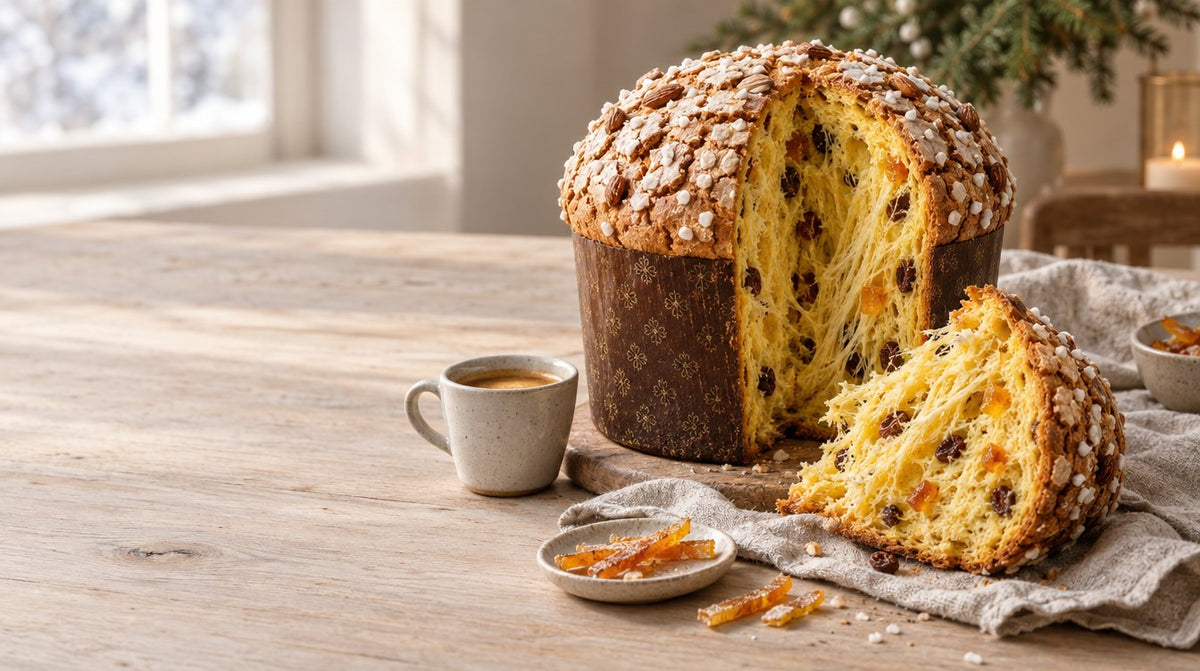
Panettone is not a bread, and it is not a cake. It is something in between: a tall, soft sweet bread with butter, egg yolks, vanilla and candied fruit that Italians eat at Christmas. Cut into a good panettone and the crumb pulls apart like cotton. It weighs almost nothing in your hand, and still two slices are plenty.
We spent two months feeding our starter every day before we baked our first one. Here we explain what makes panettone so special and what the process looks like if you want to try it yourself.
Panettone in 10 seconds
- StarterPasta Madre, 43-45 % water
- Ready to usepH 4.1-4.3
- The doughTwo days, two mixes
- FlourStrong flour, W300 and above
What is panettone?
Panettone comes from northern Italy and is eaten all over the country around Christmas. It is tall and round and baked in a paper mould. Inside are raisins and candied orange and lemon, hidden in a golden crumb that smells of butter, vanilla and citrus with a soft, tangy note from the sourdough.
Because the dough is soured by the starter and full of butter and eggs, a real panettone stays fresh for a long time. We carried three panettoni home from Naples in our suitcase. They still tasted good half a year later.
Classic or modern panettone?
There are two kinds. The classic one has a dense, even crumb, soft and moist, but without big holes. The modern one has an open crumb with large, irregular holes that stretch into long strands when you tear off a piece. That is the one we make.
The difference is in the starter. A mature Pasta Madre keeps the dough in a narrow window where the gluten network is strong enough to hold on to the gas. If the starter is too sour, it has broken down its own gluten and the dough collapses. If it is too weak, the dough rises flat and dense.
pH is the key. The small window between pH 4.1 and 4.3 decides whether your panettone turns out like cotton or like a brick. A cheap pH meter is the best investment if you want to bake panettone.
Pasta Madre: the starter behind panettone
For bread we use a liquid starter. For panettone we use a stiff starter, Pasta Madre, with only 43-45 % water. It is a different culture with different bacteria, and it needs to be built up well in advance.
- Start with your regular starter when it is active and rising well.
- Make it stiffer over three feedings 18-24 hours apart: first 65 % water, then 55 % and finally 45 %.
- Feed it every day and keep it at 16-18 °C. Roll it out, shape it like a snail and leave it in a container overnight.
- Measure the pH before you bake. It is ready when it sits between 4.1 and 4.3.
We have written a full guide on how to turn a liquid sourdough into a Pasta Madre.
How the bake works
A panettone is made over two days with two doughs. It is not difficult, but it takes time and a mixer that can knead for a long time without warming the dough.
| Step | What happens | Time |
|---|---|---|
| First dough (primo impasto) | Flour, water, sugar, Pasta Madre, butter and egg yolks are mixed into a strong dough | 30-45 minutes of mixing |
| First rise | The dough rises at 26-28 °C until it has tripled | 10-16 hours |
| Second dough (secondo impasto) | The rest of the flour, sugar, honey, vanilla, butter, egg yolks and fruit | 45-60 minutes of mixing |
| Second rise | In the mould, until the dough is 5 cm from the rim | 6-12 hours |
| Baking and cooling | The panettone hangs upside down so it does not collapse | At least 4-8 hours |
Keep the dough cool. The dough must not go above 30 °C while mixing. If it gets too warm, the butter melts out and the gluten network cannot hold.
The ingredients matter
- Flour: A very strong flour with a W index above 300, for example Italian Manitoba. The stronger the flour, the longer the dough can ferment without collapsing.
- Butter: Unsalted with 84 % fat. We have had good results with Arla, Thise, Lurpak and Debic.
- Egg yolks: Choose ones with a deep orange colour. They give the crumb its golden colour.
- Vanilla: Real vanilla beans lift a panettone more than anything else.
The full recipe
The full recipe with all amounts, temperatures, the glaze and what we learned from visiting Francesco Di Salvo in Naples is in our e-book Panettone and Pasta Madre. It makes two panettoni of about 1 kg.
Questions and answers
Can you use a regular sourdough starter for panettone?
You can, but you will get a different kind of bread. Panettone gets its soft, stringy crumb from a stiff Pasta Madre with a low pH. Start with your regular starter and make it stiffer over three feedings.
How long does it take to make a Pasta Madre?
The conversion itself takes three feedings 18-24 hours apart. But a Pasta Madre gets better from being fed every day for a few weeks before you bake with it. It took us two months to get the balance right.
How long does a panettone keep?
A panettone baked with sourdough, butter and eggs stays fresh for several weeks when it is wrapped well. Ours from Naples tasted good for half a year.
What is the difference between panettone and colomba?
It is the same kind of dough. Colomba is baked in the shape of a dove and eaten at Easter, often with almond and orange in the glaze.
Share on socials:
Sourdough Rolls in a Stand Mixer: Easier Than You Think